Agencies can differentiate in 2026 by focusing on strategy, automation, specialization, and long-term client value instead of relying only on AI tools. Artificial intelligence is not a deal anymore. It is what everyone is doing. By 2026, agencies in the US and UK will all be using tools like ChatGPT, automation platforms, and Artificial Intelligence-driven analytics. In 2025, reports said that over 78% of agencies were using artificial intelligence in at least one important part of their work. Now in 2026, it looks like that number will be over 90%.
So the question is not “Should you use artificial intelligence?”
It is “How do you stand out when everyone else is already using it?”
This guide will show you real-world ways to help freelancers, solopreneurs, and agencies stand out with details on how to work, what to charge, and how to get things done.
The Reality: AI Has Leveled the Playing Field
Artificial intelligence tools have removed obstacles.
Now, a solo freelancer in the UK can do things like:
- Make ad copy in a few minutes
- Build automation systems without knowing how to code
- Deliver reports faster than an agency could in 2022
That means:
- Speed is not a deal anymore
- The quality of work is getting more similar
- Prices are going down in markets
In simple terms, artificial intelligence is making it so that how well you do things is not as important as it used to be.
Why Agencies Can Differentiate with Smarter AI Strategies
In the present era, the agencies may create differentiation from their rivals in the market through smarter usage of artificial intelligence rather than just depending upon automation. Though most of the companies have started to adopt the same artificial intelligence technology in order to remain competitive in the industry, the key differentiator would be how the agencies will be able to utilize such AI tools in building processes, communicating with customers, automating routine jobs, and delivering results. It is thus evident that in the year 2026, smart strategies for AI would prove to be an effective tool for agencies.
Differentiation Strategy #1: Shift from “Execution” to “Outcome Ownership”
Most agencies are still selling tasks like the following:
- “We will run your ads.”
- “We will manage your SEO.”
- “We will automate your workflows.”
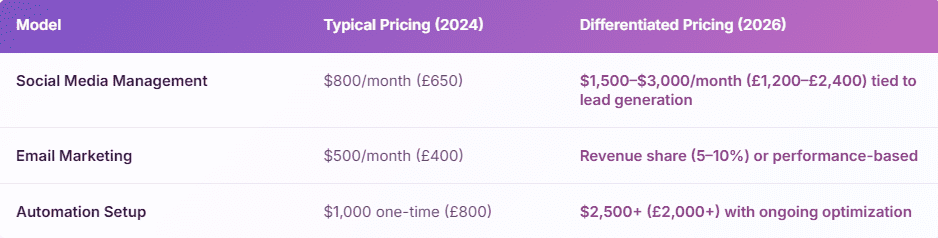
The best agencies in 2026 are selling results.
Example Pricing Shift (US vs UK)
Practical Insight
Clients do not care if you use artificial intelligence. They care if you can increase their revenue, reduce their costs, or save them time.
Differentiation Strategy #2: Build Proprietary AI Workflows (Not Just Use Tools)
Anyone can use tools. Not many people build their own systems.
Real Workflow Example #1: AI-Powered Client Onboarding System
A freelance agency can set up a system that has a step-by-step process:
- A potential client fills out a form on the website or on Typeform
- The data is sent to Google Sheets
- It triggers an automation using n8n or Zapier
- Artificial intelligence analyses the client’s needs using ChatGPT
- It generates a custom proposal, pricing tier, and recommended strategy
- It sends the proposal by email within 5 minutes
Tools Used
- n8n or Zapier for automation
- ChatGPT for analysis and content
- Google Sheets as a database
Insider Insight
What usually goes wrong is that artificial intelligence makes proposals if the prompts are not set up properly.
To fix this, you can use pre-defined frameworks and constraints in the prompts.
This is where real differentiation happens. Not in the tools you use. In how you set them up.
Differentiation Strategy #3: Specialize Aggressively (Niche Down Hard)
General agencies are having a tough time in 2026. The agencies that are winning are the ones that specialise in something.
For example:
- AI automation for real estate agencies
- Lead generation for UK law firms,
- Email systems for SaaS startups
Why this works
AI helps specialists grow faster than generalists. It is also easier to create systems that can be repeated. And when you specialize in something, people think you are an authority in that area, so you can charge more.
Real Market Observation
In the US, clients are willing to pay 2-3 times more for specialists than for agencies.
Differentiation Strategy #4: Productize Your AI Services
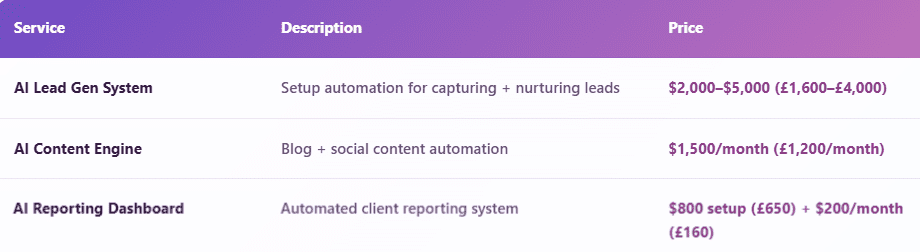
Instead of doing custom work every time, create packages of services that you can repeat.
Example Productized Offers
Why It Works
It gets the job done faster.
It is easier to scale.
It is clear what the client is getting.
Explore more on AI for Agencies: 7 Powerful Strategies to Scale Faster in 2026.
Differentiation Strategy #5: Combine AI + Human Strategy (Hybrid Model)
AI alone is not enough to get the job done. The top agencies use AI to execute plans.
Humans have to come up with a strategy, position themselves, and make decisions.
Pros & Cons
Pros
- You can get the job done faster without sacrificing quality
- Clients trust you more
- You can charge
Cons
- You need a team with the right skills
- The workflow is complicated
Differentiation Strategy #6: Own the Data (Not Just the Output)
Most agencies rely on tools from outside.
The advanced agencies build their own internal dashboards, custom tracking systems, and client-specific insights.
Real Workflow Example #2: AI Reporting System
- You can pull data from Facebook Ads and Google Analytics
- store it in a database
- Use AI to summarize the performance
- Highlight any anomalies
- suggest improvements,
- Auto-generate a report.
Result
This can save you 5-10 hours per week per client. Improve retention.
Explore: How AI Can Help Agencies Improve Client Reporting and Retention
Differentiation Strategy #7: Build AI-Powered SOPs
Without systems, AI can create chaos. With systems, AI can help you scale.
Real Workflow Example #3: SOP Automation
- You can set up a document workflow
- convert it into a standard operating procedure
- integrate AI prompts at each step
- automate the repetitive parts.
Comparison: Generic AI vs Differentiated Agency
https://chatgpt.com/
Final Thoughts
- The year 2026 will mark the end of innovation when the use of AI tools alone will fail to distinguish one agency from another, as all businesses will be able to employ similar technology. The key will lie in the way that agencies will be able to utilize their knowledge of AI to develop effective strategies for delivering products and services that will allow them to benefit from automation, personalized client service, and reporting capabilities.
- Agencies can differentiate by combining AI automation with human creativity and strategy.
- Modern agencies can differentiate themselves through specialized AI workflows and scalable systems.
- Agencies can differentiate more effectively when they focus on outcomes instead of basic execution.
- In 2026, agencies can differentiate themselves by offering productized AI-powered services.
- Agencies can differentiate faster when they build strong operational systems around AI.
- Small agencies can differentiate by niching down and solving specific client problems.
Businesses will be interested in developing scalable systems that offer efficient processes and effective reporting. Agencies that will concentrate on the development of such systems will have a competitive advantage. On the other hand, the role of human factors such as creativity, decision-making, and relationship-building will not become redundant in marketing automation.