
Thought leadership with AI is becoming a powerful strategy for professionals who want to stand out in a crowded digital market. By combining expertise with AI tools, consultants and creators can produce high-quality content consistently and build authority faster than ever before. In the high-stakes markets of the US and the UK, the “AI-generated” label is really bad for authority. By the year 2025, the internet will be full of low-value content. This led to what people who study the market call “algorithm fatigue”.
As we go through the year 2026, “algorithm fatigue” clients are willing to pay a lot of money. We are talking about $5,000 to $25,000 or more in 2026, and in the UK, that is £4,000 to £20,000 or more. For specialised expertise, they are not looking for people who just make content. These premium clients are looking for architects of insight, people who can give them ideas and perspectives.
According to reports from the industry, specialised expertise is key. In 2026, 86 per cent of the people who buy consulting services now want to work with partners who use AI. If they think the partner is not coming up with original ideas, use AI. They will stop working with them. To be successful in this situation, you need to stop using AI to write things and start using it as an intelligence engine to make your own unique perspective stronger. You need to use AI as an intelligence engine to help you, not to do the work for you. This way, you can show premium clients that you have the expertise they are looking for.
The Shift from Content Creation to “Insight Engineering”
In 2024, being a thought leader was about producing a lot of content. In 2026, it’s different. Now it’s about cutting through the noise and getting the message across.
High-end clients in London and New York want something
- They are looking for “Deep Work” results that only humans and AI working together can achieve.
- To be a thought leader now, you need Insight Engineering.
- This means using AI to analyse large amounts of your own data, client trends, and market changes.
- Then you create a point of view (POV) that no one else has.
- There’s a trap to avoid: just asking ChatGPT to write a blog post about analysing leadership.
- The result is usually generic and not very useful.
- The right strategy is to take your 2026 keynote or client meeting recordings.
- Feed them into a custom AI tool to find “uncommon truths” posts about them that go against what everyone else is saying in your industry.
This way, you can create original content. Your clients will appreciate the effort you put into getting to the bottom of things. You and your Insight Engineering will be seen as thought leaders. e
Learn more about how AI as a consultant productises your expertise with a coach consultant.
Architecting Your “Authority Flywheel” with AI Agents
The successful solo entrepreneurs in 2026 are not spending hours on LinkedIn. They are using agentic workflows to have a presence all the time.
Here is their workflow:
The “One-to-Many” Insight Capture
Record a 10-minute “braindump” on an industry problem using Otter.ai or Fireflies.ai.
Then they synthesise the recording. They use a tuned Claude 3.5/4 or GPT-5 prompt that has their “brand voice synthesis DNA” preloaded.
Next, brand voice: they distribute the content. They use n8n.make.com. Next, to turn one transcript into the following: make.com
- A detailed LinkedIn newsletter.
- A technical whitepaper for business stakeholders in the UK.
- Five “Contrarian” threads on X, which are threads on Twitter.
Using AI for “Hyper-Personalized” Outreach (The $10k+ Client Play)
Cold outreach is not working anymore. People want you to know what their business is about before you send them a message. This is what is expected from you in 2026. If you have clients, they want you to understand their business before you contact them.
The “Clay” way of finding leads for big sales
There are tools like Clay that cost around 149 dollars per month. These tools help you combine information about a company with intelligence to make sense of it.
Let us say you want to contact the CEOs of financial technology companies in the UK. These companies should have more clients than 50 employees.
The intelligence part: Clay looks at the company’s latest report, finds a specific problem they are facing, and writes a first line that is very relevant to them.
The result is a message that says: “I saw on page 14 of your report from the quarter that you are moving into the MENA region. I helped a company, [Competitor], with a similar problem of growing their business…”
Building “Minimum Viable Authority” with Custom GPTs
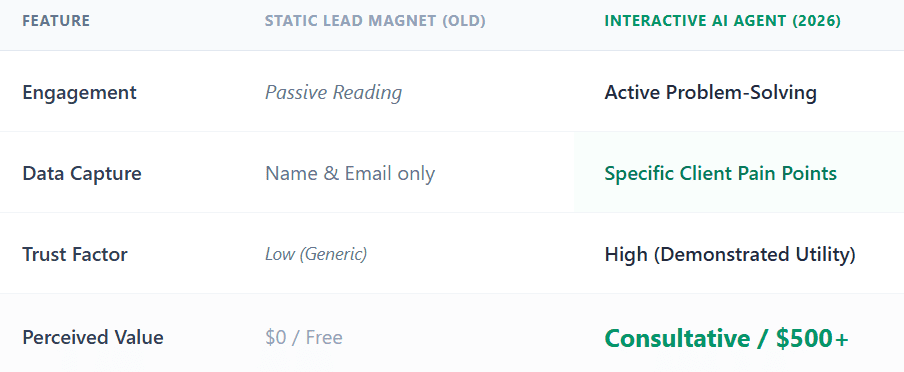
In 2026, your lead magnet should not be a PDF. It should be an interactive expert. UAE,
You can do this by building a Custom GPT or a Typeform AI researcher. This lets potential clients interact with your methodology.
For example, an interactive expert, a London-based HR consultant, could build a UK employment law stress-tester AI. This way, people can really see what you do and how you can help them with UK employment law. example,
By using an interactive expert in employment law. Like a UK employment law stress-tester AI interactive expert, you can show clients that you really know what you are doing with UK employment law. employment law stress-tester AI,
Lead Magnet vs AI Agent
Pricing and ROI: Selling “outcomes” in employment law. Not “Hours”
The United Kingdom and United States markets are moving towards value-based pricing. “Outcomes” is artificial intelligence-value-based pricing. helps you do ten hours of research in ten minutes. Artificial intelligence, you should not charge clients for those ten minutes that artificial intelligence is working.
2026 Pricing Benchmarks
An artificial intelligence-enabled strategy audit can cost between two thousand five hundred dollars and seven thousand five hundred dollars, or between two thousand pounds and six thousand pounds.
Ongoing authority management. An artificial intelligence-enabled strategy audit can cost between three thousand dollars and ten thousand dollars per month, or between two thousand five hundred pounds and eight thousand pounds per month.
The strategic advice for authority management is to be transparent about your humanity. The strategic advice-in-the-loop human process. Clients in 2026 pay money for the loop of human judgment, money for that which checks the artificial intelligence judgement output. This means clients want to know that a real person is looking at the work that artificial intelligence does.
Case Study: Scaling a Solo Consultancy from £5k to £20k Months
Consider Sarah, a marketing strategist who works remotely from Manchester.
The problem she faced was getting stuck in a routine of writing emails for a fee of seventy-five pounds per hour. The AI solution she found was quite helpful. She used tools like Zapier and OpenAI’s artificial intelligence API to create a tool called the Brand Sentiment Analyser. OpenAI’s This tool was designed for her line of work. She rebranded herself as an AI-powered growth architect analyser to reflect her approach.
The outcome was impressive. From a powered growth architect just selling emails, Sarah started selling Data-Driven Market Dominance Packages. Emails: the results were significant. Her delivery time decreased by sixty per cent. Packages. She was able to triple her package price because she offered in-depth insights compared to a traditional marketing agency. Sarah’s percentage. Sarah’s work now focuses on providing insights to her clients. Her new approach has made her services more attractive to clients.
The Risks: Avoiding the “AI Content Slop” Penalty
Google’s 2025 and 2026 core updates are very strict on sites that publish AI text. To keep your site in standing with E-E-A-T, which stands for Experience, Expertise, Authoritativeness, and Trustworthiness, here are some tips:
- Add your personal story: AI can’t tell a story about a time when a product launch went wrong or a tough boardroom negotiation. These are the experiences that set you apart.
- Localising your content is also crucial. For example, if you’re writing for a UK audience, use English and mention UK-specific rules like GDPR and HMRC. On the other hand, if you’re writing for a US audience, focus on KPIs and terms that are relevant in the US.
- Fact-check everything: The 2026 AI models can still get some facts wrong, especially when it comes to legal or financial information. One incorrect reference can damage years of building authority and trust. So make sure to check all your facts.
Final Thoughts: The Future of the “Indie” Thought Leader
The difference between the “Commodity Freelancer” and the “Premium Consultant” is getting bigger. In 2026, artificial intelligence is making things more equal. It helps the person working alone have the research abilities of a McKinsey analyst and the same distribution abilities as a mid-sized agency.
- Building thought leadership with AI allows professionals to share insights at scale without burning out.
- Many experts are using thought leadership with AI to create consistent, high-impact content.
- The advantage of thought leadership with AI is the ability to publish faster while maintaining quality.
- If you want to grow your authority, you must focus on thought leadership with AI strategies.
- Thought leadership with AI helps attract premium clients who value expertise and clarity.
- In 2026, thought leadership with AI is no longer optional for serious professionals.
- Thought leadership with AI enables you to consistently share valuable insights while saving time and effort.
-
Those who invest in thought leadership with AI will dominate their niche.
To be successful, you need to change the way you think about yourself. You are not the one doing all the work anymore. You are the one telling the artificial intelligence what to do and how to do the work. The “Commodity Freelancer” and the “Premium Consultant” are two different things now. The “Commodity Freelancer” and the “Premium Consultant” need to adapt to this way of working with artificial intelligence.

Muhammad Hashir Khan is the founder and author of Pushtopeak and a BSCS graduate with over 3 years of experience in artificial intelligence, data science, and software development. His focus is on understanding how AI tools work in practical scenarios and how they can be applied to improve productivity and workflow efficiency. Through his writing, he shares structured insights to help freelancers and professionals use AI tools more intelligently and strategically.