
AI for agency reporting is transforming how modern agencies track performance, communicate results, and retain clients in 2026. Agencies that are successful are not the ones that do a lot of work. They are the ones who show the value of their work better and faster.
Client reporting has become an important thing that helps agencies keep their clients. According to the industry reports from the year 2025, more than 68 percent of agencies lose their clients because they do not communicate well and do not clearly show the return on investment, not because they do not do good work. The market analysis in the year 2026 shows that agencies that use artificial intelligence to make reports see 20 to 35 percent rates of client retention.
If you are a freelancer or you own an agency in the United States or the United Kingdom, this guide will show you how to use artificial intelligence to make client reporting a way to keep clients, not something you do every month.
Why Traditional Client Reporting Is Failing in 2026
Most agencies still follow this outdated workflow:
- They export data from different tools by hand
- They paste the data into Google Sheets
- They make dashboards that do not change
- They send reports to clients once a month as a PDF file
This way of doing things creates a lot of problems:
- Clients do not understand how your work is helping them
- Reports are late. Do not have the latest information
- There is no story behind the numbers; the numbers themselves
- The reports are not personalized for each client
The result is that clients start to question the value of your work, and eventually, they leave.
If you’re looking to build a complete AI-driven agency system beyond reporting, you should also read AI for Agencies: How to Scale Service Delivery, Improve Client Retention, and Increase Margins in 2026, where we break down full automation frameworks used by modern agencies.
Why AI for Agency Reporting Matters in 2026
How AI Changes Client Reporting (Beyond Automation)
AI does not just automate reporting. It turns it into a system that helps you make decisions.
Key Shifts AI Enables:
- From reports to real-time updates
- From data to actual insights
- From reports to stories that fit each client
- From updates to talking to clients all the time
Instead of just sending numbers, you send clear answers to business questions:
- What got better this month?
- What was the return on investment?
- What should we do next?
Real-World AI Reporting Workflow (Step-by-Step)
This is not an idea. This is how some agencies are already working.
Step 1: Data Collection Automation
You can use tools like the following:
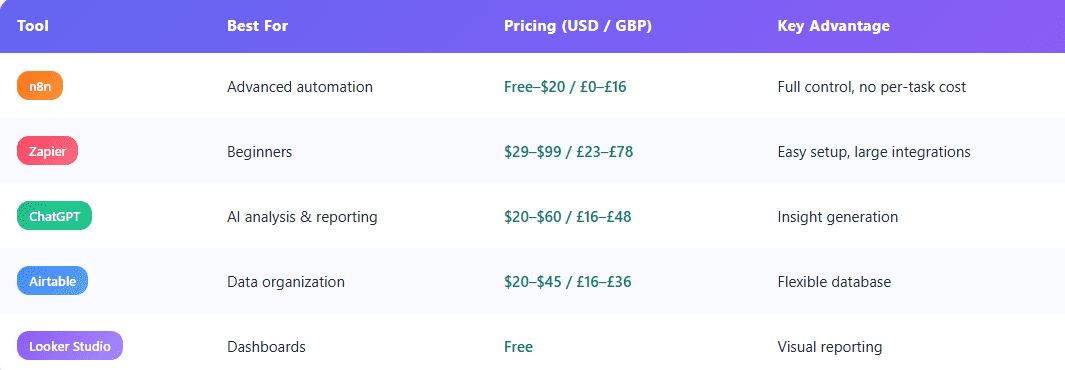
n8n (you host it yourself). It does not cost much.
Zapier (easy to set up for beginners)
Workflow Example:
Pull data from Facebook Ads, Google Analytics, and your CRM
Store it in Google Sheets or Airtable
Set it to run automatically every day
Cost:
n8n: $0 to $20 per month (you host it yourself)
Zapier: $29 to $99 per month (around £23 to £78)
Step 2: AI Data Analysis with ChatGPT
Feed structured data into AI (via API or automation):
Prompt Example:
“Analyse this weekly ad performance data. Highlight key improvements, risks, and opportunities.”
ChatGPT will give you:
- Insights into performance
- Analysis of trends
- Suggestions for improvement
Step 3: Automated Report Generation
Convert insights into client-friendly reports:
- Summarize key points
- Put into a PDF or a simple dashboard
- Send automatically by email or WhatsApp
Advance Tip:
Get ChatGPT to write in a way that clients understand:
- For technical clients, use specific metrics
- For Non-technical clients, keep it simple
Step 4: Smart Notifications & Alerts
Instead of waiting for monthly reports:
- Let clients know when important numbers change
- Warn them when performance drops
- Suggest what to do
This keeps clients engaged, which helps keep them as clients.
AI Tools Comparison for Client Reporting
How AI Directly Improves Client Retention
Clarity Equals Trust
Clients will stay with you when they understand the results you give them.
AI helps you:
- Translates data into language that is easy to understand.
- Shows the impact clearly so clients know what is going on.
- Removes confusion so clients are not left wondering what is happening.
Proactive Communication
Instead of:
“Here’s your report.”
You say:
“Your CPA dropped 18% this week — here’s why and what we’ll do next.”
This is how you become a partner to your clients, not someone who provides a service.
Personalization at Scale
AI allows you to do things that were not possible before.
- You can make custom reports for each client.
- You can give them tailored insights that are just for them.
- You can give them recommendations that are specific to their industry.
Even if you have 20+ clients, each one of them will feel like they are your priority.
Faster Response Time
Clients do not like waiting for things to happen.
AI enables you to do things quickly.
- You can analyze things instantly.
- You can give them reports on time.
- You can make decisions quickly, so clients do not have to wait.
Advanced Strategy: AI-Powered Client Dashboards
Instead of sending PDFs, build live dashboards.
Example Setup:
- Data: Google Analytics + Ads
- Automation: n8n
- AI: ChatGPT
- Frontend: Notion or custom dashboard
Features:
- Weekly insights that get updated automatically
- Recommendations that are made by the AI system
- Tracking of numbers
Charge clients:
For something called an “AI Reporting System”, you can charge them between $150 and $500 per month or £120 to £400.
Once you start offering AI-powered dashboards, the next step is packaging them as a premium service — this is exactly what we explain in How Agencies Can Productize AI Services Without Lowering Perceived Value.
Use Case: Freelance Marketing Agency (USA/UK)
Let us say you have a business where you help people with paid ads.
Before using AI, you probably spent a lot of time each month making reports for your clients. This could be around 4 to 6 hours per month per client. The problem was that the clients did not really understand what they were getting for their money, so they would often leave.
After using AI, things got better. You now only spend around 30 minutes per month on each client because the system does everything automatically.
The clients also get insights into what is going on, so they are happier and stay with you longer.
The result of all this is that you save around 20 hours/month, and you can keep more of your clients, 25 to 40% more.
Pros and Cons of AI Client Reporting
Pros
- It saves you time and cuts down on manual work
- It makes things clearer and helps you communicate better
- It gives you insights in real time
- It is easy to scale when you have clients.
Cons:
- It takes time to set up at first, like five to ten hours
- It works best when you have structured data
- If you rely on it too much, you might not use your own judgment as much
Strategic Insight: Reporting Is Your Retention Engine
Most agencies are focused on:
- Getting clients
- Running campaigns for them
The thing that really gives you an edge is the following:
How do you show results
If your reports are:
- Easy to understand
- Sent to clients before they even ask for them
- Full of information
Clients will:
- Stay with you longer
- Trust you more
- Pay you more to keep working for them
In a market where almost every agency is starting to use AI, your real advantage comes from how you apply it. We cover this in depth in How Agencies Can Differentiate in 2026 When Everyone Is Using AI.
Final Thoughts
- AI for agency reporting helps businesses automate performance tracking and reporting workflows.
- Many modern businesses now rely on AI for agency reporting to improve transparency with clients.
- One major advantage of AI for agency reporting is faster and more accurate data analysis.
- Agencies investing in AI for agency reporting can improve long-term client retention.
- In 2026, AI for agency reporting is becoming a standard for scalable agencies.
- AI for agency reporting enables teams to create detailed performance reports with minimal manual effort.
If you are still sending reports in 2026, you are already behind the times. AI is not something that helps you get work done faster; it is a way to get ahead of others.
Agencies that win will:
- Turn reporting into storytelling
- Use AI for communication
- Build systems, not tasks
The change is simple, but it makes a big difference: Stop reporting data; start delivering clarity. That is what clients actually pay for.