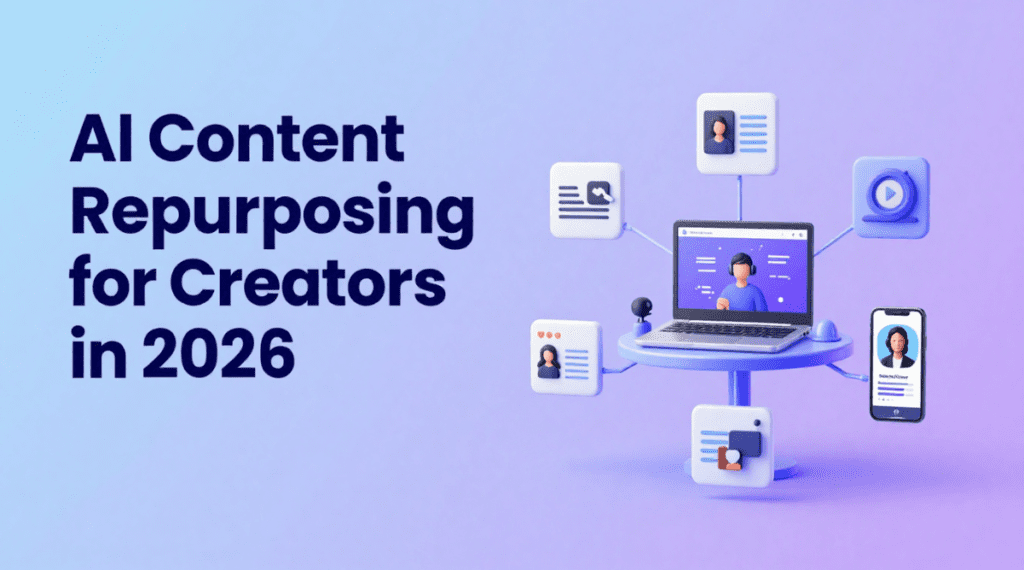
AI content repurposing is one of the most powerful ways creators can scale content without creating from scratch. In the year 2026, making content is not about making more of it. It is about getting the most out of every piece of content that you make.
The reports from the year 2025 say that more than 72 percent of the best content makers in the United States and the United Kingdom use their content on four or more platforms. They also keep their audience engaged all the time. The thing that makes them different is that they use artificial intelligence to repurpose their content. They do not do it by hand.
If you make podcasts or videos or write newsletters, this guide will show you how to take one idea and turn it into more than ten different things. We will use ways of working and real tools and systems that actually work.
Why AI Content Repurposing Is a Competitive Advantage in 2026
Repurposing content is not a thing. Artificial intelligence has changed it from a task that you do by hand into a system that can be used by many people.
What changed in 2025–2026?
Artificial intelligence can now understand the context, the tone, and what the audience wants. Tools that automate tasks allow you to do everything without having to do it by hand. People expect to see content in different forms now, like video, text, short messages, and email. This is what is happening in the real world in the United States and the United Kingdom.
Real-world impact (US & UK creators)
People who work for themselves in the United States charge between 300 and 800 dollars per month for services that repurpose content. Agencies offer special packages that they call “Content Multiplication Systems”. Content makers who use Artificial Intelligence to repurpose their content say they can make two to four times more content without getting tired
Learn more about AI for Creators and Media Professionals: 7 AI Workflows for Creators in 2026: Create Faster Without Losing Quality.
The Core Idea: One Content → Multiple Assets
You know, top creators don’t make content every day. They use a model:
Example Workflow:
One podcast episode can become the following:
- A YouTube video
- short clips for Reels, TikTok, and Shorts
- A Twitter thread
- A LinkedIn post
- A newsletter
- A blog article
This is where AI comes in handy. It helps with transforming content, not just creating it.
You can learn more about How Creators Can Use AI to Turn One Idea Into Videos, Posts, Newsletters, and Shorts.
Here’s a step-by-step AI repurposing workflow that actually works:
Step-by-Step AI Repurposing Workflow (Proven System)
Step 1: Capture and Transcribe Content
Use tools like:
- Whisper AI, which is free and works locally
- Descript, which costs $12 a month or around £10
- Riverside, which is popular among creators, in the US
The goal is to turn audio and video into an accurate transcript.
Step 2: Structure Content with AI
Use tools like ChatGPT or other language models to do things.
First, they can help you find the ideas in a piece of content.
They can also help you identify parts that will grab people’s attention.
Then they can break the content into parts.
Prompt Example:
“Convert this podcast transcript into 5 content angles for LinkedIn and YouTube Shorts with strong hooks.”
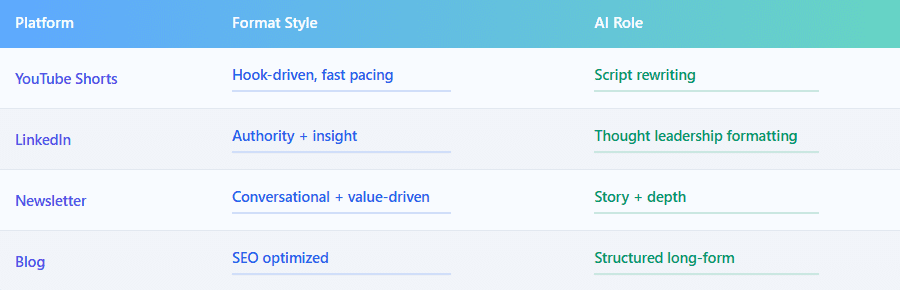
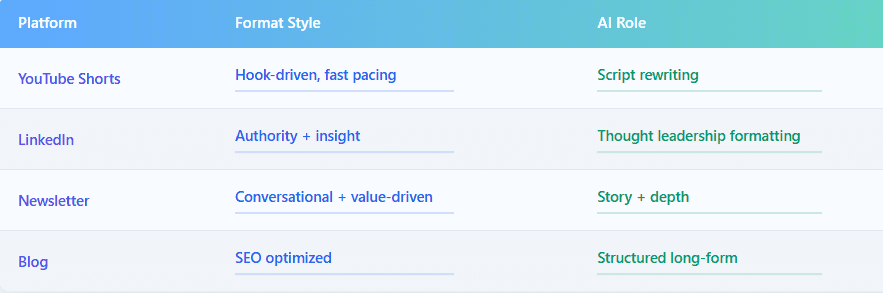
Step 3: Format for Different Platforms
Step 4: Automate the Workflow
A lot of people who create things stop at making stuff. They do not go further than that.
Advanced creators do things differently. They use tools to help them work smarter.
These tools are:
- n8n, which you can use on your computer, and it does not cost a lot of money
- Zapier, which costs between 19 and 69 dollars every month, or between 15 and 55 pounds
- Google Sheets to move data around
Example Automation System:
You upload a podcast. Then a transcript is made automatically. Then a computer program summarises what the podcast is about.
The podcast is then broken down into types of content, like the following:
- Blog posts
- Newsletters
- Social media posts
All of these are saved in Notion or Google Docs.
Then they are scheduled to be shared with others.
Real Use Case: Freelancer Content System (USA & UK Market)
It is called the Freelancer Content System, and it is used in the United States and the United Kingdom. Let us say you are a freelance content strategist and you live in London or New York. You work with clients. You have a special way of doing things.
Every week, you record a podcast for your client. Then a computer program turns the podcast into the following:
- 2 blog posts
- 1 newsletter
- 8 social media posts
You charge your client an amount of money for this service.
Pricing Strategy:
- Package: $500–$1200/month (£400–£950)
- Deliverables: 30–50 content pieces/month
- Cost: Mostly AI tools ($30–$100/month)
Best AI Tools for Content Repurposing (2026 Comparison)
Advanced Strategy: Build a “Content Engine”, Not a Workflow
Building a Content Engine is an idea. This is because people who work on their own think about what tasks they need to do. People who earn a lot of money think about how to make systems that work well.
A content engine has parts. First, you put something in, like a podcast, a video, or just an idea. Then you use computers and artificial intelligence to process it. After that, you get content that you can use on different platforms. You can use tools to schedule when your content goes out. Then you get feedback from people, which helps you make it better.
You can learn more about How Creators Can Use AI to build a Consistent Content System Instead of Burning Out.
Maintaining Quality While Scaling with AI
A major concern in the US/UK market is content quality and authenticity.
Best Practices:
- Always check what the AI makes before you share it with people.
- Do not just share it without looking at it.
- You can keep your voice by using special instructions and style guides.
- You should add your own thoughts and ideas, not just repeat what other people say.
You can also learn more about How Creators Can Use AI Responsibly in 2026 Without Hurting Trust, Quality, or Audience Connection.
Pros and Cons of AI Content Repurposing
Pros:
- time savings of 5 to 10 hours every week
- You can produce 3 to 5 times the content
- Your content gets seen on platforms
- It helps freelance services grow
Cons:
- There is a risk of your content sounding the same if you use AI too much
- You need to spend time setting up automation
- AI content needs editing by a human to be good
- Tools like n8n can be hard to learn
Strategic Insight: Why Most Creators Still Fail
In 2026, most creators still:
- Only use AI for writing
- Do not automate their workflows
- Treat each platform separately
What top creators do differently:
- They think about content as a system
- They focus on getting their content there, not just making it
- They build systems that can be repeated
Learn more about How to Use AI to Grow a Personal Brand Without Sounding Generic.
Final Thoughts: The Future Is Content Leverage, Not Content Creation
AI content repurposing helps creators turn long-form content into multiple formats easily. With AI content repurposing, you can stay consistent across platforms without extra effort. The main goal of AI content repurposing is to maximize reach from a single idea. Creators who use AI content repurposing grow faster with less workload.
The creators who win in 2026 are not the ones making new stuff every day. They are the ones getting the most out of what they made.
If you are a freelancer, solopreneur, or content creator in the US or UK:
Stop thinking, “What should I make today?”
Start thinking, “How can I get 10 times the value from what I already made?”
AI is not taking the place of creators. It is helping them work like media companies.
FAQ
-
AI can transcribe podcasts, extract key ideas, and rewrite them into platform-specific formats like LinkedIn posts, Twitter threads, and short-form video scripts.
-
What are the best AI tools for content repurposing in 2026?
Top tools include ChatGPT for structuring, Descript for transcription, n8n for automation, and Zapier for beginner-friendly workflows.
-
Is AI content repurposing suitable for freelancers?
Yes – freelancers can build high-value service packages offering content repurposing systems, charging $300–$1200/month (£240–£950).
-
How do you maintain quality when using AI for content?
Always edit outputs, maintain a consistent tone, and add personal insights instead of relying purely on AI-generated text.
-
Can one piece of content really be turned into multiple formats?
Yes — a single podcast or video can be transformed into blogs, newsletters, social posts, and short videos using AI workflows.

Muhammad Hashir Khan is the founder and author of Pushtopeak and a BSCS graduate with over 3 years of experience in artificial intelligence, data science, and software development. His focus is on understanding how AI tools work in practical scenarios and how they can be applied to improve productivity and workflow efficiency. Through his writing, he shares structured insights to help freelancers and professionals use AI tools more intelligently and strategically.