It is becoming essential for creators to use AI responsibly to maintain trust and content quality. In the year 2026, artificial intelligence is not something that sets you apart from others anymore. What really matters is how you smartly use artificial intelligence.
For people who create things, work on their own, and do jobs from home in the United States and the United Kingdom, the challenge is not about being fast. The challenge is about being trustworthy, coming up with ideas, and connecting with the people who watch or read what you create.
Reports from the year 2025 say that more than 72 percent of the people who watch or read things can tell when something is made with low-quality artificial intelligence. When things feel like they were made by a machine or are too general, people do not engage with them much. On the one hand, looking at the market in 2026, we see that creators who use artificial intelligence and also add their own thoughts and ideas do much better than those who only use artificial intelligence. They do 3 to 5 times better when it comes to getting people to take action.
This guide will show you how to use artificial intelligence without hurting your credibility, what makes your brand special, and your long-term growth.
Why Responsible AI Use Matters More Than Ever in 2026
Tools like ChatGPT, n8n, and Zapier have made it possible to create a lot of content quickly. They have also made content less special.
The real risk:
- People who watch or read your content will feel like something is missing when it does not have a personal touch
- Brands will lose their authority when they say things that everyone else says
- Places like Google and YouTube will prioritize content that feels authentic
The real opportunity:
- Artificial Intelligence can help you think and come up with ideas; it does not have to replace your thinking
- You can create a lot of content without getting too tired
- You can build systems that work well instead of just looking for quick fixes
If you haven’t already, read a guide on the following: 7 AI Workflows for Creators in 2026: Create Faster Without Losing Quality.
The Core Principle: AI Should Assist. Not Replace. Your Thinking
The biggest mistake creators make is using AI as a robot writer or a thinking partner.
Bad workflow (common in 2025):
- Prompt
- Generate
- Copy
- Publish
High-performance workflow (2026 standard):
- Idea
- Outline
- AI helps to expand
- refines
- Publish
Practical example (freelancer use case):
A UK freelance copywriter charges £150–£500 per article. They use AI to:
- Summarize research summaries
- Create content structure
- Draft tough sections
But they manually:
- Add client insights
- Adjust tone
- Optimize for conversion
Result: Faster delivery without losing premium positioning.
Build an “AI + Human Layer” Content System
Instead of using AI, randomly build a system with layers.
Step-by-step system:
Input Layer (Human Thinking)
- Define audience (US SaaS founders vs UK consultants)
- Clarify goal (lead generation vs education)
AI Processing Layer
Use tools like:
- ChatGPT for ideas and drafts
- Notion AI for organizing
- Perplexity AI for research
Human Enhancement Layer
- Add real-world examples
- Inject opinions and experience
- Refine tone for the audience
Distribution Layer
Automate publishing with n8n or Zapier
Real-World Workflow: AI Content System for Freelancers
Here’s a practical workflow used by many US/UK creators:
Example: LinkedIn + Blog Content Engine
- Research topics using AI
- Generate blog outline
- Write long-form content
- Break into:
- LinkedIn posts
- Twitter threads
- Email newsletter
Automate publishing using n8n.
You should read the blog on How Creators Can Use AI to Turn One Idea Into Videos, Posts, Newsletters, and Shorts.
ROI impact:
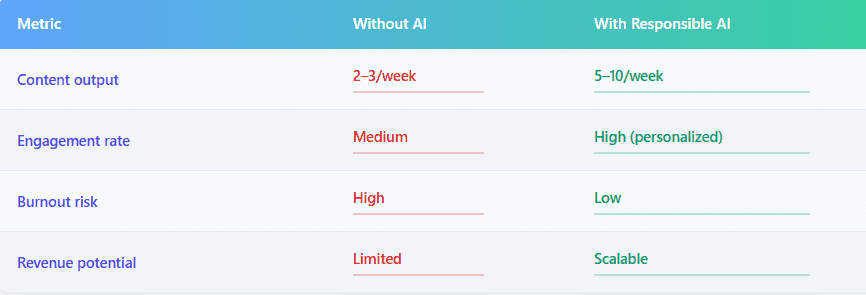
The goal is not just to use AI, but to use AI responsibly in every stage of content creation. Brands that use AI responsibly build stronger and long-lasting audience relationships.
AI Transparency: Should You Tell Your Audience?
This is a topic that people are talking about in 2026.
The reality:
- The reality is that you do not need to say “This was written by AI” every time.
- You should do a few things to be honest with your audience.
- You should maintain a voice when you are writing or speaking.
- You should also avoid making claims that are not true.
- You should make sure the content you create reflects what you know about the subject, which is your expertise.
Best practice:
The best way to use AI is as a tool, not as who you are. You can build trust with your audience by being consistent and getting results. There are times when being transparent about using AI can be helpful.
For example, if you are creating content about AI, or if you are offering consulting services, or if you are working in an industry that has a lot of rules, it is a good idea to be transparent.
Avoiding the “Generic AI Content Trap”
Most people who create content make a mistake here. They let AI generate content that sounds much like it was written by a machine.
You can tell if your content sounds much like it was generated by AI if it has repetitive phrasing, if it does not have any real examples, if it only gives surface-level advice, or if it does not have any strong opinions.
Fix it with this framework:
- You can add things like experience, case studies, and data-backed insights.
- You can remove things, like fluff introductions, overused phrases, and generic conclusions.
If you want to learn more, you can dive into How Media Professionals Can Use AI to Speed Up Research, Scripting, and Editing Without Losing Originality.
Tools Comparison: Responsible AI Stack for Creators
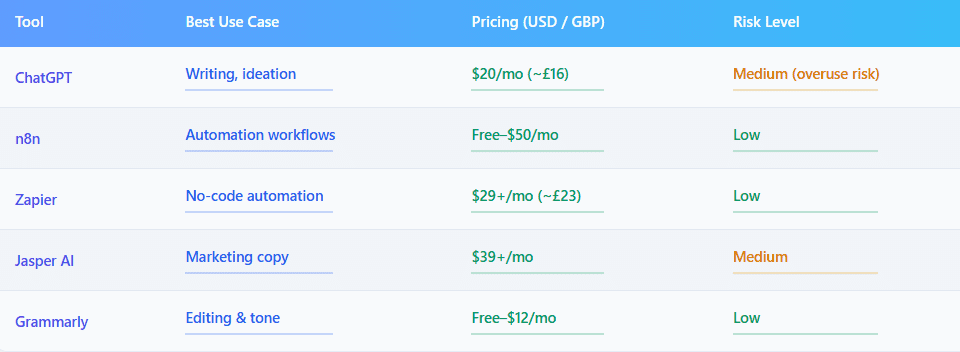
To build long-term trust, you must learn to use AI responsibly across all platforms.
Pros and Cons of Using AI in Content Creation
Pros:
- Faster content creation without needing a big team
- Scalable systems help entrepreneurs
- AI improves research and gives new ideas
- Consistent publishing is
Cons:
- Risk of losing ideas
- Overusing AI reduces thinking
- Audience trust drops if AI is misused
- Content feels similar across platforms
How to Maintain Audience Connection in an AI-Driven World
Inject personality into every piece
Your tone is what sets you apart.
Use storytelling
AI can’t replicate your experiences or mistakes.
Speak to a specific audience
For example:
- Startup founders in the US
- Consultants in the UK
Focus on outcomes, not content volume
Content that works > content that fills space
Building Trust While Scaling With AI
Trust comes from:
- Consistency
- Accuracy
- Value
Strategic tip:
Use AI to scale delivery, but use human input to scale trust.
You can learn more about How Creators Can Use AI to Build a Consistent Content System Instead of Burning Out.
Advanced Strategy: AI for Client Work (Freelancers & Agencies)
Example workflow:
- Client onboarding form
- AI analyzes requirements
- Draft generated
- Human refinement
- Delivery + revisions
Tools Used:
- ChatGPT
- n8n
- Google Docs
This approach:
- Reduces the time it takes by forty to sixty percent.
- Keeps the quality of the work high.
- Makes clients happier.
Final Thoughts: The Creators Who Win in 2026
Creators must use AI responsibly to avoid losing audience trust. When you use AI responsibly, you ensure your content remains authentic and valuable.
The people who will be successful in 2026 are not the ones who work the fastest.
They are the ones who:
- Use AI strategically
- Maintain Authenticity
- Build systems instead of looking for quick fixes.
AI is like a tool that helps you. If your ideas are not good, AI will just make them worse. If your ideas are good, AI will make them even better. If you want sustainable growth, you need to use AI responsibly in your workflows.
FAQ
-
How can creators use AI without losing authenticity?
By using AI for structure and efficiency while adding personal insights, stories, and opinions manually.
-
Is it ethical to use AI for content creation in 2026?
Yes, as long as the content remains truthful, valuable, and not misleading. Transparency matters in certain industries.
-
What are the best AI tools for creators in 2026?
Top tools include ChatGPT, n8n, Zapier, Grammarly, and Notion AI for structured workflows.
-
Does AI-generated content hurt SEO rankings?
Poor-quality AI content does. High-quality, human-refined AI content performs well when aligned with E-E-A-T principles.
-
How do freelancers use AI responsibly for client work?
They use AI for drafting and research but ensure final output is customized, strategic, and aligned with client goals.

Muhammad Hashir Khan is the founder and author of Pushtopeak and a BSCS graduate with over 3 years of experience in artificial intelligence, data science, and software development. His focus is on understanding how AI tools work in practical scenarios and how they can be applied to improve productivity and workflow efficiency. Through his writing, he shares structured insights to help freelancers and professionals use AI tools more intelligently and strategically.