

Speed up research using AI is becoming essential for creators and professionals who want faster and more accurate results. In 2025 and 2026, media professionals are competing on who builds systems, not who works harder. Freelancers, journalists, YouTubers, podcasters, and remote media teams in the US and UK are using AI-powered workflows to cut production time without losing originality or creative identity.
But here’s the reality most blogs ignore:
The advantage doesn’t come from using AI tools. It comes from how you structure your workflow around them.
This guide shows how to use AI for research, scripting, and editing while preserving your authenticity, voice, and editorial quality.
Why AI Is Reshaping Media Workflows in 2026
According to 2025 industry reports, over 68% of freelance media professionals in the US and UK use AI in at least one stage of content production.
Here’s what market analysis in 2026 shows:
- AI-assisted research reduces production time by 40–60%
- Script drafting time drops by 50% or more
- Editing and post-production efficiency improves by 30–45%
Professionals who rely too heavily on AI without editorial control often face problems like the following:
- Generic output
- Loss of brand voice
- Decline in audience trust
That’s why the focus is shifting toward AI-assisted workflows, not replacing humans with AI.
If you’re building an AI content ecosystem, check out 7 AI Workflows for Creators in 2026: Create Faster Without Losing Quality.
The Core Principle: AI as a “Second Brain”, Not a Replacement
Top media pros see AI like this:
- A research helper
- A partner for drafting
- A tool to optimize post-production
—not as the person who creates the product.
The Rule of 3 Layers (Used by top freelancers)
- AI Layer → Speed + structure
- Human Layer → Insight + originality
- Editorial Layer → Quality + polish
This approach helps keep your content:
- Unique
- High-value
- Trustworthy
How to Use AI for Research Without Producing Generic Content
The Problem:
Most creators use AI to research and get summaries.
The Solution:
Use AI with sources instead of just one prompt.
A Practical Workflow (Used by freelance journalists)
Here’s a step-by-step plan:
1. Use ChatGPT for topic expansion:
“List emerging angles [topic] for US and UK audiences in 2026.”
2. Cross-check using:
- Google Trends
- Reddit discussions
- Industry reports
3. Feed findings back into AI:
“Identify gaps and unique insights from this data.”
Advanced Tip (High ROI)
Use automation tools like the following:
n8n (free/self-hosted)
Zapier ($20–$50/month / £16–£40)
To:
- Get data from sources
- Summarize automatically
- Store insights in Google Sheets
Real Use Case
A YouTube creator in the UK cut research time from 3 hours to 45 minutes using a workflow that
- Collected trending topics
- Summarised insights with AI
- Created content angles
AI-Powered Scripting: Faster Drafts Without Losing Your Voice
The Biggest Mistake People Make:
They let artificial intelligence write entire scripts without really understanding what they are about.
The Better Approach:
You should use a combination of prompts and voice training to get the best results.
Script Workflow That Works
Step 1: Provide context
Think about who your audience is, like US freelancers or UK creators, and what kind of tone you want to use, such as educational, storytelling, or analytical.
Step 2: Use modular prompts
Do not say something like
“Write a script for a YouTube video.”
Instead, try this:
- Come up with a hook to grab people’s attention
- Write the script one section at a time
- Make sure the call to action is strong
Step 3: Inject your voice
- Train the artificial intelligence using:
- Scripts you have written before
- Blog posts you have made
- Guidelines for your tone that you have written down
Example of a Good Prompt Strategy
- “Write 3 hooks for a YouTube video targeting UK freelancers struggling with content consistency.”
- “Expand hook #2 into a storytelling intro with a real-world scenario.”
- “Rewrite in a conversational but authoritative tone.”
ROI Insight
Media professionals who charge:
$150 to $500 or £120 to £400 per script
can now:
- Finish two to three times more projects
- Keep the quality high
- Make more money each month
Once your script is ready, you can extend its value by repurposing it into multiple formats using AI, as explained in How Creators Can Use AI to Turn One Idea Into Videos, Posts, Newsletters, and Shorts.
Editing with AI: Speed Without Sacrificing Quality
Editing is where artificial intelligence really helps out.
Key Tools Used in 2026
- Use ChatGPT to make structural edits
- Use Descript to edit audio and video
- Use Grammarly to make sure it is clear and sounds good
After editing, content can be adapted for multiple platforms, as detailed in How Podcasters, Video Creators, and Newsletter Writers Can Use AI to Repurpose Content Efficiently.
Editing Workflow
- First, use intelligence to make structural edits
- Make it flow better
- Get rid of anything that is repeated
- Make sure the voice is consistent
- Then have a person review it
- Add some feeling, emotion, and intention to it
Pro Tip: “The 80/20 Editing Model”
- AI handles 80% technical cleanup
- Humans handle 20% emotional and strategic refinement
Comparison: Manual vs AI-Assisted Media Workflow
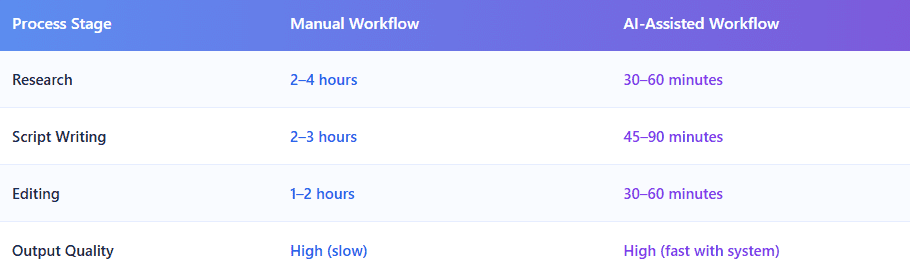
The ability to speed up research using AI gives you a competitive advantage in content creation. When you speed up research using AI, you can gather insights in minutes instead of hours.
Building a Complete AI Workflow System (Freelancer Setup)
Here is a real-world system used by remote professionals like me:
Tools I Use
- ChatGPT for scripting and editing
- n8n for automating workflows
- Google Docs for storing content
- Notion for managing ideas
How it Works
- A client submits a request through a form.
- This is what happens next:
- n8n triggers topic research
- AI summarizes the research
- A script is generated in a format
- I edit it using AI and human review
- The final product is delivered within 24 to 48 hours
Why This Matters
- As a freelancer in the US and UK, I compete with others on:
- Speed
- How quickly I turn things around
- Consistency
If you struggle to maintain consistency, you should also explore How Creators Can Use AI to Build a Consistent Content System Instead of Burning Out, which breaks down sustainable content workflows.
Maintaining Originality While Using AI
Most professionals struggle with this.
5 Proven Methods
- Add real-world examples from your experience
- Include opinions and insights AI cannot generate
- Use data interpretation, not just data
- Customize tone for your audience
- Avoid copy-paste outputs
Reality Check
AI can generate content, no doubt. It can’t replicate my experience, client interactions, or strategic thinking. That’s your competitive edge.
Maintaining a unique voice is critical, and this becomes easier when you apply strategies from How to Use AI to Grow a Personal Brand Without Sounding Generic.
Pros and Cons of Using AI in Media Workflows
Pros
- Artificial Intelligence in Media Workflows can get work done faster
- It helps you work on projects at the same time
- It reduces the feeling of being tired
- Artificial intelligence in media workflows can be used for big or small projects.
Cons
- The work it does can seem similar to everything else
- Relying too much on Artificial Intelligence in Media Workflows can make you less creative
- You need to spend time setting up an artificial intelligence system for media workflows.
- The quality of the work done by artificial intelligence in media workflows depends on the information you give it.
Cost Breakdown

Experts speed up research using AI by combining multiple tools for faster and more accurate results. If you want to speed up research using AI, start by automating data collection and summarization.
Final Thoughts: The Real Competitive Advantage in 2026
Many professionals speed up research using AI to improve productivity and reduce manual effort. AI is not your edge. It is your system that gives you an advantage. Media professionals who are successful in 2026 do the following:
- Build workflows that they can repeat
- Human insight together
- Focus on being fast and creating content
The simplest way to speed up research using AI is to use it for filtering and organizing large amounts of information. There is a growing gap between those media professionals who use AI just for fun and those who use it in a planned way. To grow your business without getting tired, you cannot ignore AI anymore. It is how you use AI that will determine whether you succeed. You must use AI to improve your system. Your system and AI will give you an edge.
FAQ
-
Can AI replace media professionals in 2026?
No. AI enhances productivity but cannot replace human creativity, storytelling, and strategic thinking.
-
How do freelancers use AI without sounding generic?
By combining AI output with personal insights, real examples, and audience-specific tone.
-
What is the best AI workflow for content creation?
A structured system including research automation, modular scripting, and AI-assisted editing with human refinement.
-
Is AI content acceptable for clients in the US and UK?
Yes—if it maintains originality, quality, and human oversight.

Muhammad Hashir Khan is the founder and author of Pushtopeak and a BSCS graduate with over 3 years of experience in artificial intelligence, data science, and software development. His focus is on understanding how AI tools work in practical scenarios and how they can be applied to improve productivity and workflow efficiency. Through his writing, he shares structured insights to help freelancers and professionals use AI tools more intelligently and strategically.