Turn one idea into multiple content pieces is a powerful strategy that creators use to scale content using AI. In 2026, creating content is not about making a lot of it. It is about creating a system for your content.
According to reports from 2025 to 2026, people who take one idea and turn it into different types of content get 3 to 5 times more people to see and interact with it. This is compared to people who post one thing at a time. Most people who work for themselves in the US and UK still make each piece of content one at a time. That is where artificial intelligence comes in and changes everything.
Instead of asking, “What should I post today?”, high-performing creators now ask: “How can I turn one strong idea into a week’s worth of content across platforms?”
This guide will show you how to create a system like that using artificial intelligence tools like ChatGPT, n8n, and Zapier. We will give you examples of how to do it, explain the cost, and show you how to make it work well. We will not just give you advice.
Why One Idea → Multi-Format Content Is the Smartest Strategy in 2026
Nowadays, the people who create content are rewarded for sharing it across many platforms, not just for making it.
Key Market Insight
- People who make content in the US spend 50 to 300 dollars per month on tools, but they do not use them well
- People who work for themselves in the UK are starting to use automation to reduce their workload by about 40 percent
Looking at the market in 2026, we can see that taking one idea and turning it into many types of content can create up to 65 percent of the leads that come into a business
Strategic Advantage
When you take one idea and turn it into many types of content:
- You get the most value out of each idea
- You can keep posting content all the time without getting too tired
- You can make your content visible on different platforms because each platform is different, like LinkedIn is not the same as TikTok or email
The Core AI Content Repurposing Framework
The main framework for using artificial intelligence to turn one idea into many types of content. Instead of just posting things at random, use this structured plan:
Step 1: Start With a “Core Idea Asset”
This can be:
- Something you learned from a client
- A problem that is trending in your industry
- Something that happened to you, which is the type of content that works best in the US and UK markets
For example:
“Why most freelancers lose clients due to slow response time.”
Step 2: Expand Using AI (ChatGPT Workflow)
Use ChatGPT to turn your idea into:
- A long post for LinkedIn or a blog
- A version for a newsletter
- A script for a video
- Short hooks to grab people’s attention
Prompt Example:
“Turn this idea into a LinkedIn post, email newsletter, YouTube script, and 5 short-form hooks. Maintain a professional tone for a US/UK audience.”
Step 3: Format for Each Platform
Each platform has different consumption behaviours:
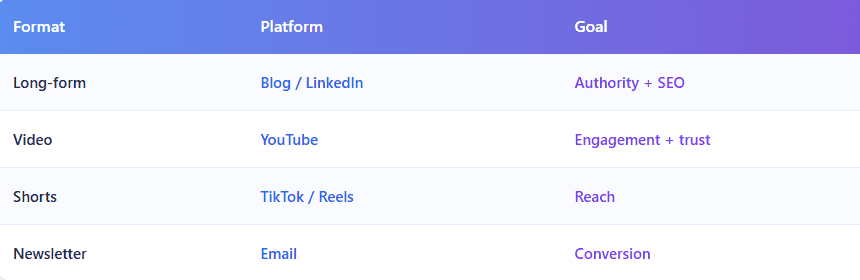
The easiest way to scale is to turn one idea into multiple content pieces using AI tools.
If you want to go deeper, check out this complete guide on AI content repurposing to understand how creators scale content across platforms.
Step 4: Automate Distribution (n8n/Zapier)
Instead of posting manually:
- Use n8n; it’s free, and you can host it yourself or try Zapier, which costs between $20 and $100 per month or £16 to £80.
- Automate these tasks:
- Schedule your content
- Send emails
- Publish in the media
Real Workflow Example:
Google Docs → n8n → LinkedIn, Twitter, and Email
ChatGPT output → Airtable → auto-post using Zapier
Real Workflow: Turn One Idea Into Multiple Content Assets
Let’s break down a real-world creator workflow:
Input Idea:
“AI can replace 60% of repetitive freelance tasks.”
Output System:
- Write a Blog Post for SEO
- Target keyword: AI automation for freelancers
- Make it 1200+ words long
- Create a LinkedIn Post
- Tell a story that grabs attention
- Ask people to comment on ‘AI’ for a workflow
- Make a Newsletter
- Add a story and how you can make money with it
- List the tools and their prices
- Write a YouTube Script
- Make it 5–8 minutes and structured
- Add examples and case studies
- Create Shorts or Reels
- Use five hooks, like:
- “You’re wasting 10 hours a week doing this
- “AI isn’t replacing you. But someone using AI will”
- Write a Twitter Thread
- Break it down into 5–7 tweets
For deeper workflows, see how media professionals use AI to speed up research, scripting, and editing without losing originality.
Best AI Tools for Content Repurposing (2026 Comparison)
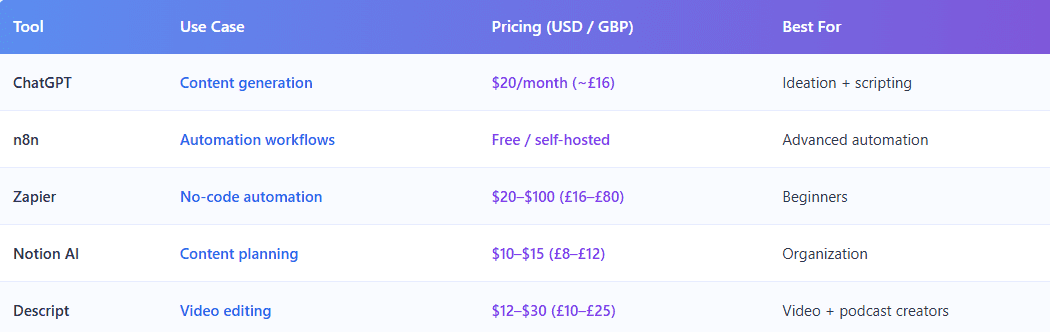
When you turn one idea into multiple content pieces, you can scale your content strategy without extra effort.
Advanced Strategy: Build a “Content Engine”, Not Just Posts
Most creators fail because they think in terms of individual posts rather than as part of a whole system.
What a Content Engine Looks Like:
- One idea leads to expansion through AI
- Stored in Notion
- Automated tagging of topic, format, and audience
- Scheduled distribution through automation tools
- Performance tracking through CTR, engagement, and leads
Real Example (Freelancer Use Case)
A consultant based in the UK
- Creates 2 ideas every week
- Uses ChatGPT and n8n
- Generates:
- 2 Blogs
- 6 Posts for LinkedIn
- 4 Emails
- 8 Videos
Result:
- The consultant got 3 times as many leads in just 60 days
- The consultants’ workload was reduced by 50 percent
This approach also helps in building a strong identity—here’s how you can grow a personal brand with AI without sounding generic.
Content Repurposing vs Traditional Content Creation
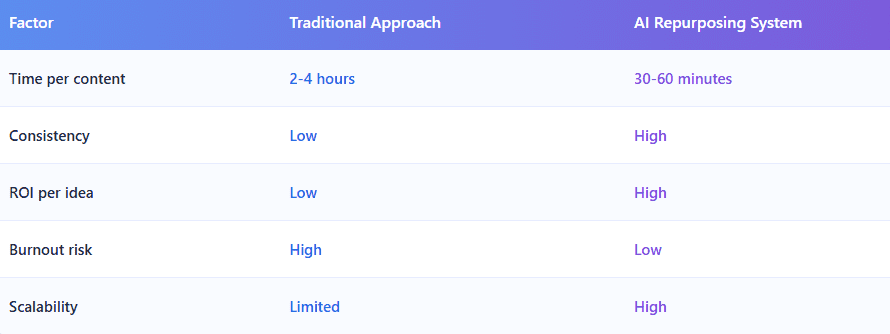
Creators who turn one idea into multiple content pieces stay consistent across platforms.
To build long-term consistency, you should also learn how creators use AI to build a content system instead of burning out.
Pros and Cons of Using AI for Content Repurposing
Pros
- Artificial Intelligence saves a lot of time, around 10 to 20 hours every week
- It helps you post content consistently across all platforms
- AI improves the quality of your content with workflows
- It can even help solo creators become like mini agencies
Cons
- There is a risk that your content will sound generic if your prompts are not good
- You need to spend some time setting up the automation systems at first
- If you rely too much on artificial intelligence, it can reduce the originality of your content if you do not manage it well
Common Mistakes Creators Make (And How to Fix Them)
Copy-Pasting Content Across Platforms
The fix is to change the format of your content for each platform because each platform is different
Using AI Without Strategy
The fix is to build workflows that just use one-off prompts with artificial intelligence.
Ignoring Distribution
The fix is to spend half of your time creating content and the other half getting it out to people
No Personal Voice
The fix is to add your personal stories and opinions to the content that Artificial Intelligence helps you create
While scaling content, it’s equally important to use AI responsibly to maintain trust and audience connection.
Final Thoughts: What Will Really Give You an Edge in 2026
Learning to turn one idea into multiple content pieces helps maximize reach and engagement. Artificial intelligence is not what gives you an edge anymore. It is the systems that you have in place that matter. Anyone can use artificial intelligence to create content. Not many people can turn one idea into multiple content pieces, such as 10 assets. Get their content out to people automatically across all platforms. Keep the quality and personal voice in their content consistent.
If you are a freelancer or creator in the United States or the United Kingdom, how well you do in 2026 will depend on how well you can turn your ideas into systems that work. Start with one idea, build a pipeline for it, and then automate the rest.
FAQ
-
How can creators use AI without losing originality?
By using AI for structure and drafts, then adding personal insights, tone, and experience to maintain authenticity.
-
What are the best AI tools for content creators in 2026?
Top tools include ChatGPT, n8n, Zapier, Descript, and Runway ML depending on your workflow needs.
-
Is AI content allowed for monetization (AdSense, clients)?
Yes, as long as the content is original, valuable, and not purely auto-generated without human input.
-
How much can AI increase content production speed?
Most creators report 2–4x faster production when using structured AI workflows.
-
Should beginners start with Zapier or n8n?
Beginners should start with Zapier for ease, then transition to n8n for scalability and cost efficiency.

Muhammad Hashir Khan is the founder and author of Pushtopeak and a BSCS graduate with over 3 years of experience in artificial intelligence, data science, and software development. His focus is on understanding how AI tools work in practical scenarios and how they can be applied to improve productivity and workflow efficiency. Through his writing, he shares structured insights to help freelancers and professionals use AI tools more intelligently and strategically.